


Efficace méthode d’usinage pour complexe profond trous !
Complexe profond trou usinage est devenu de plus en plus difficile. Pièces souvent nécessitent des caractéristiques supplémentaires, telles comme très petit trou finitions, intérieur chambres, changements dans ouverture, contours, rainures, filetages, filetages, et changement trou directions. Pour efficacement obtenir tels trous avec petites tolérances, pas seulement il exige extensif expérience et R&D ressources, mais aussi ingénierie capacités, application installations, et substantiel client implication.
Profond Trou Usinage (DHM)
C’est un type de domaine d d’usinage dominé par outils de coupe conçus spécifiquement pour des applications existantes. Beaucoup d’industries différentes impliquent profondes trou d’usinage, mais les plus largement utilisées sont les industries de l énergie et aérospatiales. à première, certaines caractéristiques de trou profond pièces peuvent sembler impossible à former, mais outil solutions non standard conçues par experts pas seulement résoudre processus problèmes, mais aussi s’assurer que ils sont exécutés à une mesure avec haute efficacité et erreur gratuit fonctionnalités.
La demande croissante pour des trous complexes et le besoin urgent de raccourcir traitement temps a promu le développement de la technologie de moderne profond trou traitement . Depuis des décennies, profond trou forage a été une méthode d’usinage efficace utilisant dure alliage coupe outils, mais le goulot d’étranglement de fond trou alésage a a commencé à émerger.
De nos jours, succès dans ce domaine d’usinage est habituellement basé sur un mélange de outil standard et spécialisé composants, qui ont expérience dans la conception spécialisée profonde trou usinage outils outils. Ces outils sont équipés de porte-outils d’outil de haute précision, support fonctions, et alésoirs intégrés, combinés avec le dernier tranchant rainure et lame matériaux, comme bien comme efficace liquide de refroidissement et puce contrôle, pour atteindre les résultats requis de haute qualité avec le taux de pénétration le taux de pénétration le plus et traitement sécurité.

Figure 1
The parts that stop deep hole machining in Figure 1 first require drilling very deep holes, and then often involve various complex feature machining. The success of deep hole machining is usually based on a combination of application standards and common tool components, which have experience in designing non-standard tools. This type of non-standard tool based on T-Max 424.10 drill bit is a part of single tube application.
In deep hole drilling, small diameter holes below 1mm are machined using hard alloy gun drills. However, for holes 15mm and above, welding edge drills are generally used, while for holes 25mm and above, adjustable blade drills are used for highly efficient drilling. Modern indexable blade technology and drilling pipe systems also provide new possibilities for specialized cutting tools for deep hole machining.
Quand le trou profondeur dépasse 10 fois la ouverture, le trou traité est généralement considéré très profond. Quand le trou profondeur atteint 300 fois le diamètre, techniques spécialisées requises et simples ou doubles tuyaux systèmes peuvent être utilisés pour perçage perçage. Dans le long processus de l’usinage au fond de ces trous, spécialisés mouvement mécanismes, outil configurations, et correctes tranchantes de coupe sont requises pour compléter le usinage de la chambre intérieure, rainures, filetages, et cavités. Support plaque technologie est autre domaine important, et il est aussi crucial dans profond trou perçage. Maintenant, comme partie de trou profond traitement technologie, il a fait fait progrès significatifs . Ceci comprend des outils de coupe qualifiés qui sont appropriés pour ce domaine et peuvent fournir des performances supérieures .
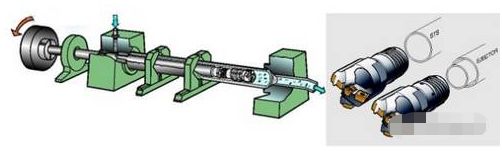
Figure 2
In deep hole machining, small diameter holes below 1mm are machined using hard alloy gun drills. However, for holes 15mm and above, welding edge drills are commonly used, while for holes 25mm and above, indexable blade drills are used to efficiently execute these processes in single tube and Ejector double tube systems. The Sandvik Keleman Deep Hole Processing Global Center can provide development, design, and testing resources for the development of part processes in the industry. In addition to small-scale applications, the center also collaborates closely with many industries that require higher parts output and touch a small number of high-quality holes, such as heat exchangers and steel billets.
The current manufacturing requirements require a deep hole machining solution that is completely different from that of deep hole drilling (which is usually carried out on other machine tools for subsequent single blade boring processes). Even on multitasking machines, this method is required for a single clamping. For example, when processing a hole several meters deep, its aperture is about 100mm, and one end must have a thread, and the inner chamber that penetrates into the hole must have a larger diameter. Usually, when drilling is completed, these features are added to the hole through the boring process after moving the part onto the lathe. Nowadays, deep hole machining combines the ability of a cutting tool to perform subsequent processes, and there are no machine tool adjustment restrictions. This new tool technology has actually expanded its operational capabilities, allowing for more efficient processing of these demanding features within a smaller range of limitations.
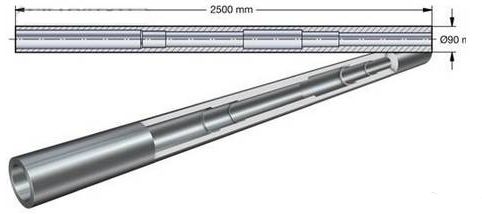
An example of using deep hole machining technology for efficient feature machining is petroleum exploration parts. This type of part is about 2.5m long and has some complex features with small tolerances. To achieve small tolerances and excellent surface finish, the tool solution first involves drilling holes with a diameter of 90mm, and then using a floating reamer for precision machining. Then, at a depth of 1.5m, the hole with a diameter of 115mm was enlarged and reamed. The other partition enters the hole approximately midway, and then it is also expanded and reamed, and processed through chamfering. Finally, perform boring and reaming to form two inner chambers with chamfers (also reamed to the finished size).
The common deep hole machining tools in the global center for deep hole machining bring non-standard disposal solutions suitable for parts in this power industry. The cutting time has been extended from over 30 hours to 7 and a half hours. This non-standard tool disposal plan can provide the required small tolerance and surface brightness throughout the relatively complex hole. The process includes one deep hole drilling and using a floating reamer to stop precision machining. Subsequently, reaching a depth of 1.5m, stop expanding and reaming the hole with a diameter of 115mm. Next, stop drilling and reaming the shorter part in another deep hole, and form a chamfer. Finally, stop boring and reaming to form two inner chambers with chamfers (also reamed to the finished size).
During routine machining, the time required to complete this part on the machine tool exceeds 30 hours. The deep hole machining solution equipped with specialized cutting tools can shorten the time to 7.5 hours.
Efficacité amélioration
Completely different from multi operation clamping, using deep hole processing technology can also achieve production efficiency improvement in large batches. It is not surprising that the cutting time has been reduced by 80%. An example that can prove capability is that proprietary technology in tool and blade design can maximize the safety of cutting edge loads. Load balancing and optimizing cutting effects on the optimal number of blades can allow for higher penetration rates, thereby reducing processing time. In terms of accuracy, small tolerances are the specialty of deep hole machining, with 70% of the holes having concentric inner diameters, a typical tolerance of 0.2mm, and a diameter tolerance of 20 microns.
Un autre exemple de haute exigences pour la coupe outils et la technologie propriétaire pendant perçage de trou perçant est le usinage de très profond trous dans le générateur arbre de une centrale électrique. dans ce cas 2c la production d’énergie industrie expert Generpro doit traiter 90 tonnes de pièces d d acier forgé dans une manière asymétrique avec des trous proches à 5,5 m long et diamètres juste plus 100mm de la ligne médiane de l arbre. ce type de trou profond doit être percé à un certain angle déviation, et la tolérance positionnelle doit être dans 8mm quand sortant.
The drilling direction, chip breakage and removal, as well as the absolute absence of waste in the pre machined shaft, are crucial for this application. The tool solution includes a dedicated drill bit and a new type of support plate. Before applying on the shaft, drilling tests are required, and the results confirm that it is more efficient and reliable - and the exit position is within 2.5mm of the target.
In many cases, the use of modern hole processing technology indicates a significant reduction in processing time - from multiple hours to less than 1 hour - and makes many complex features machinable.


